
Authors: Mr. Anubhav Roy, Prof. (Dr.) Priti Srivastava
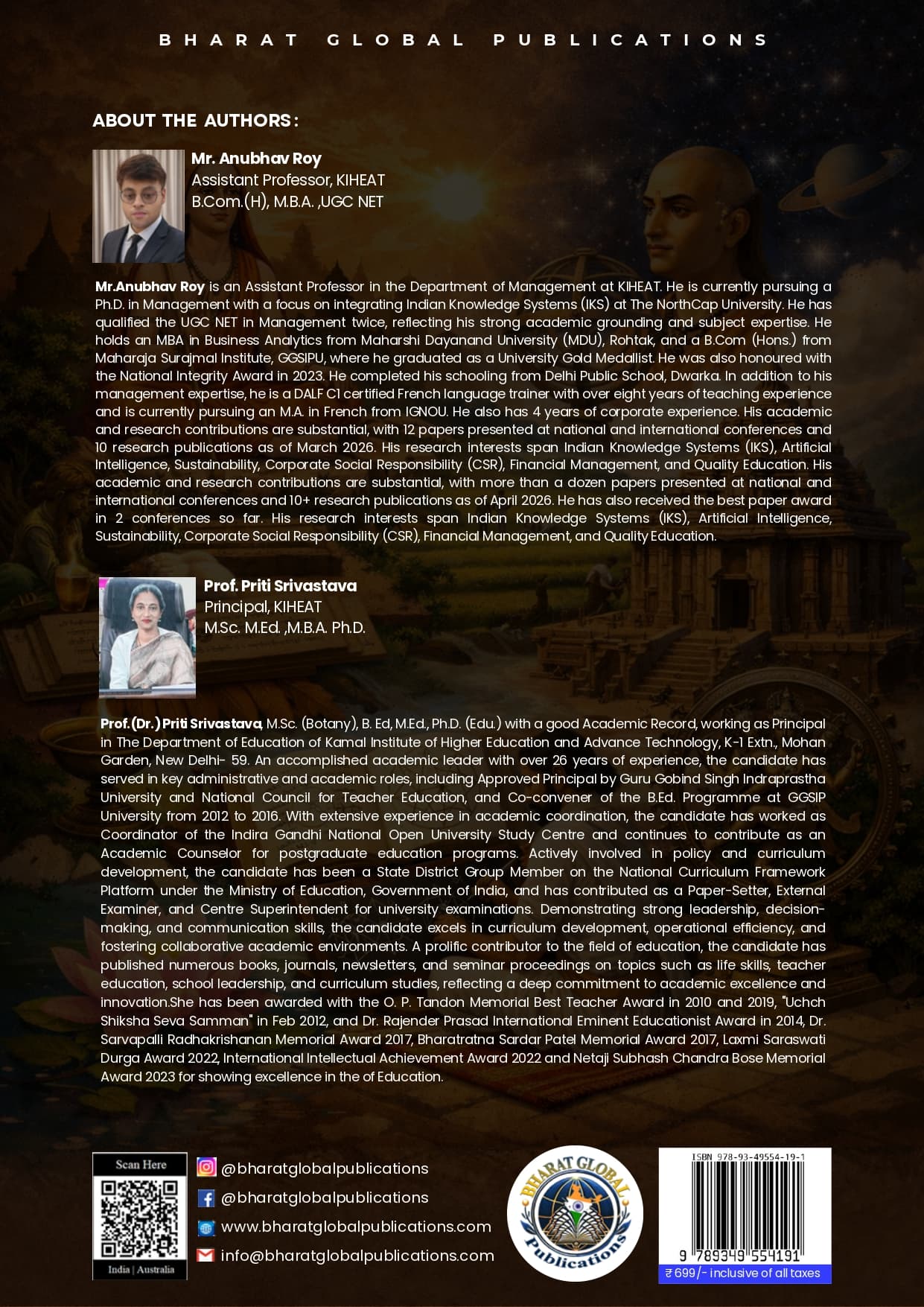
ISBN-13: 9789349554191
DOI: https://doi.org/10.5281/zenodo.20450932
Format: Paperback and e-book
Pages: 222
Product Dimensions: 6 x 9 inch
Publisher: Bharat Global Publications

Mr. Anubhav Roy is an Assistant Professor in the Department of Management at KIHEAT. He is currently pursuing a Ph.D. in Management with a focus on integrating Indian Knowledge Systems (IKS) at The NorthCap University. He has qualified the UGC NET in Management twice, reflecting his strong academic grounding and subject expertise.
He holds an MBA in Business Analytics from Maharshi Dayanand University (MDU), Rohtak, and a B.Com (Hons.) from Maharaja Surajmal Institute, GGSIPU, where he graduated as a University Gold Medallist. He was also honoured with the National Integrity Award in 2023. He completed his schooling from Delhi Public School, Dwarka.
In addition to his management expertise, he is a DALF C1 certified French language trainer with over eight years of teaching experience and is currently pursuing an M.A. in French from IGNOU. He also has four years of corporate experience.
His academic and research contributions are substantial, with more than a dozen papers presented at national and international conferences and 10+ research publications as of April 2026. He has also received the Best Paper Award in two conferences. His research interests include Indian Knowledge Systems (IKS), Artificial Intelligence, Sustainability, Corporate Social Responsibility (CSR), Financial Management, and Quality Education.
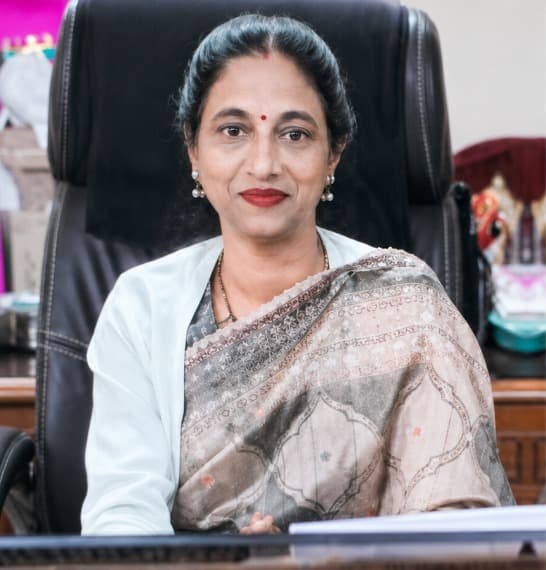
Prof. (Dr.) Priti Srivastava, M.Sc. (Botany), B.Ed., M.Ed., Ph.D. (Edu.), with an excellent academic record, is working as Principal in the Department of Education at Kamal Institute of Higher Education and Advance Technology (KIHEAT), K-1 Extn., Mohan Garden, New Delhi – 59.
An accomplished academic leader with over 26 years of experience, she has served in key administrative and academic roles, including Approved Principal by Guru Gobind Singh Indraprastha University and the National Council for Teacher Education (NCTE), and as Co-convener of the B.Ed. Programme at GGSIP University from 2012 to 2016.
With extensive experience in academic coordination, she has worked as Coordinator of the Indira Gandhi National Open University (IGNOU) Study Centre and continues to contribute as an Academic Counselor for postgraduate education programs. Actively involved in policy and curriculum development, she has been a State District Group Member on the National Curriculum Framework Platform under the Ministry of Education, Government of India. She has also contributed as a Paper Setter, External Examiner, and Centre Superintendent for university examinations.
Demonstrating strong leadership, decision-making, and communication skills, she excels in curriculum development, operational efficiency, and fostering collaborative academic environments. A prolific contributor to the field of education, she has published numerous books, journal articles, newsletters, and seminar proceedings on topics such as life skills, teacher education, school leadership, and curriculum studies, reflecting her commitment to academic excellence and innovation.
She has been honored with several prestigious awards, including the O. P. Tandon Memorial Best Teacher Award (2010 & 2019), Uchch Shiksha Seva Samman (February 2012), Dr. Rajender Prasad International Eminent Educationist Award (2014), Dr. Sarvapalli Radhakrishnan Memorial Award (2017), Bharat Ratna Sardar Patel Memorial Award (2017), Laxmi Saraswati Durga Award (2022), International Intellectual Achievement Award (2022), and Netaji Subhash Chandra Bose Memorial Award (2023) for her outstanding contributions and excellence in the field of education.
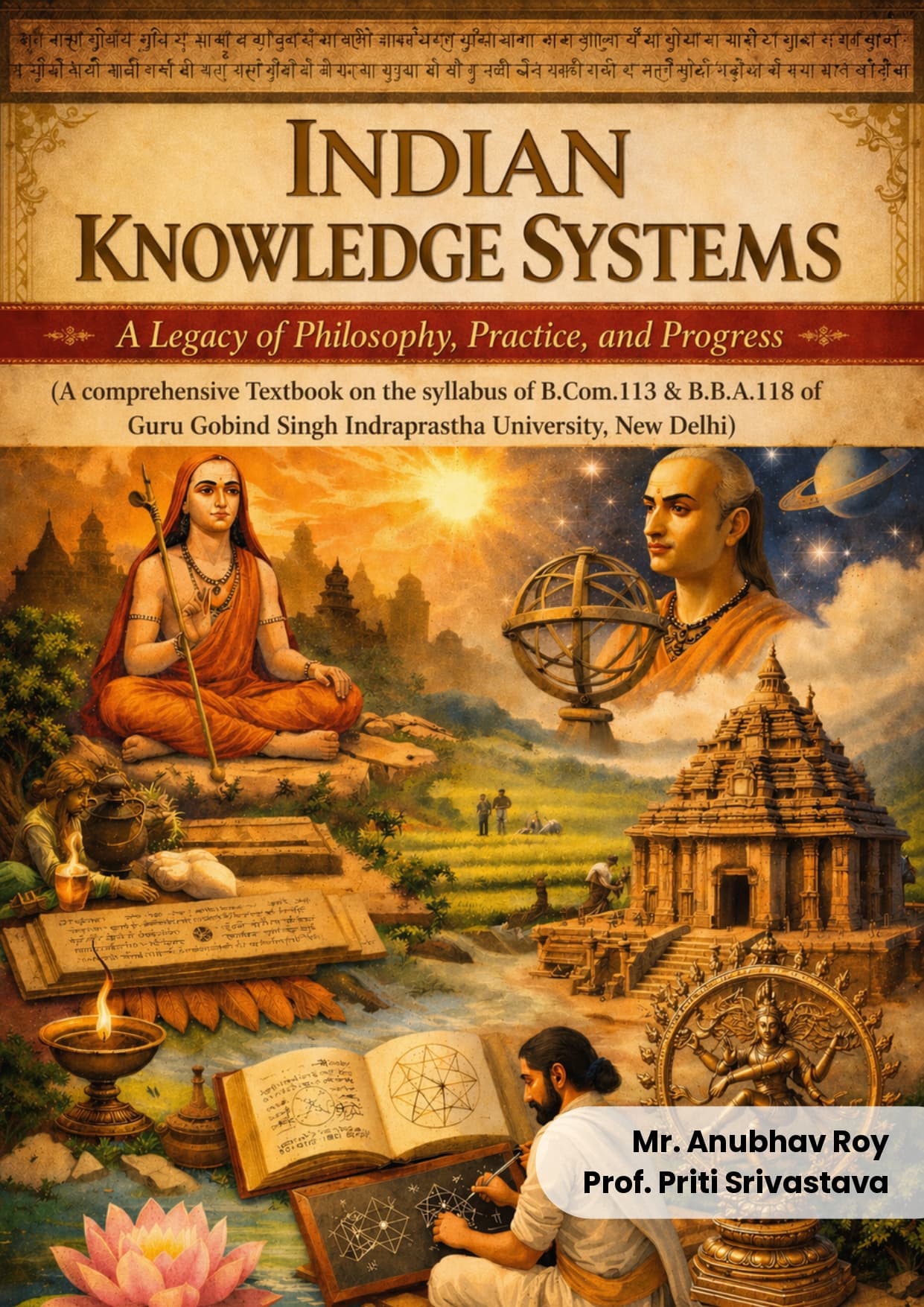
The intellectual traditions of India represent one of the most continuous and sophisticated streams of human thought. Emerging from the earliest reflections preserved in the Vedas and developing through the Upanishads and classical darśanas, this tradition reflects a sustained engagement with questions of reality, knowledge, and human purpose. Unlike systems that separate philosophy from life, the Indian knowledge framework integrates inquiry with ethical conduct, cultural expression, and spiritual realization. This text presents Indian knowledge systems as dynamic and interconnected frameworks rather than isolated historical developments. It emphasizes continuity between ritual and reflection, between metaphysics and lived practice, and between knowledge and liberation. The progression from Vedic ritualism to Upanishadic inquiry, followed by the systematic articulation of philosophical schools, illustrates a tradition that evolves through internal reflection and dialogue rather than rupture. The plurality of perspectives reflects a structured culture of debate, refinement, and intellectual openness. The work also highlights that Indian knowledge is not confined to formal philosophy. Cultural forms such as art, music, dance, architecture, and festivals function as embodied expressions of philosophical ideas. They translate abstract concepts into experiential forms, making knowledge accessible and socially embedded. The relationship between religion and spirituality is examined to show how institutional practices coexist with inner transformation and ethical awareness.
Advaita Vedanta is explored as a major philosophical culmination of this tradition, offering a rigorous account of non-duality and the nature of consciousness. Its insights into self, perception, and reality remain relevant to contemporary discussions on identity, ethics, and mental well-being.
This text has been developed in alignment with the Indian Knowledge Systems (IKS) curriculum framework of Guru Gobind Singh Indraprastha University and the broader educational vision articulated in National Education Policy 2020. The chapters are structured to support interdisciplinary learning, critical inquiry, and value-based education. By integrating conceptual clarity with cultural and practical applications, the work seeks to bridge traditional knowledge with contemporary academic needs.
In an era of rapid change and intellectual specialization, this work reframes knowledge as a transformative process that integrates understanding with responsibility. It invites the reader not only to study these traditions but to engage with them as living frameworks for reflection and inquiry.