
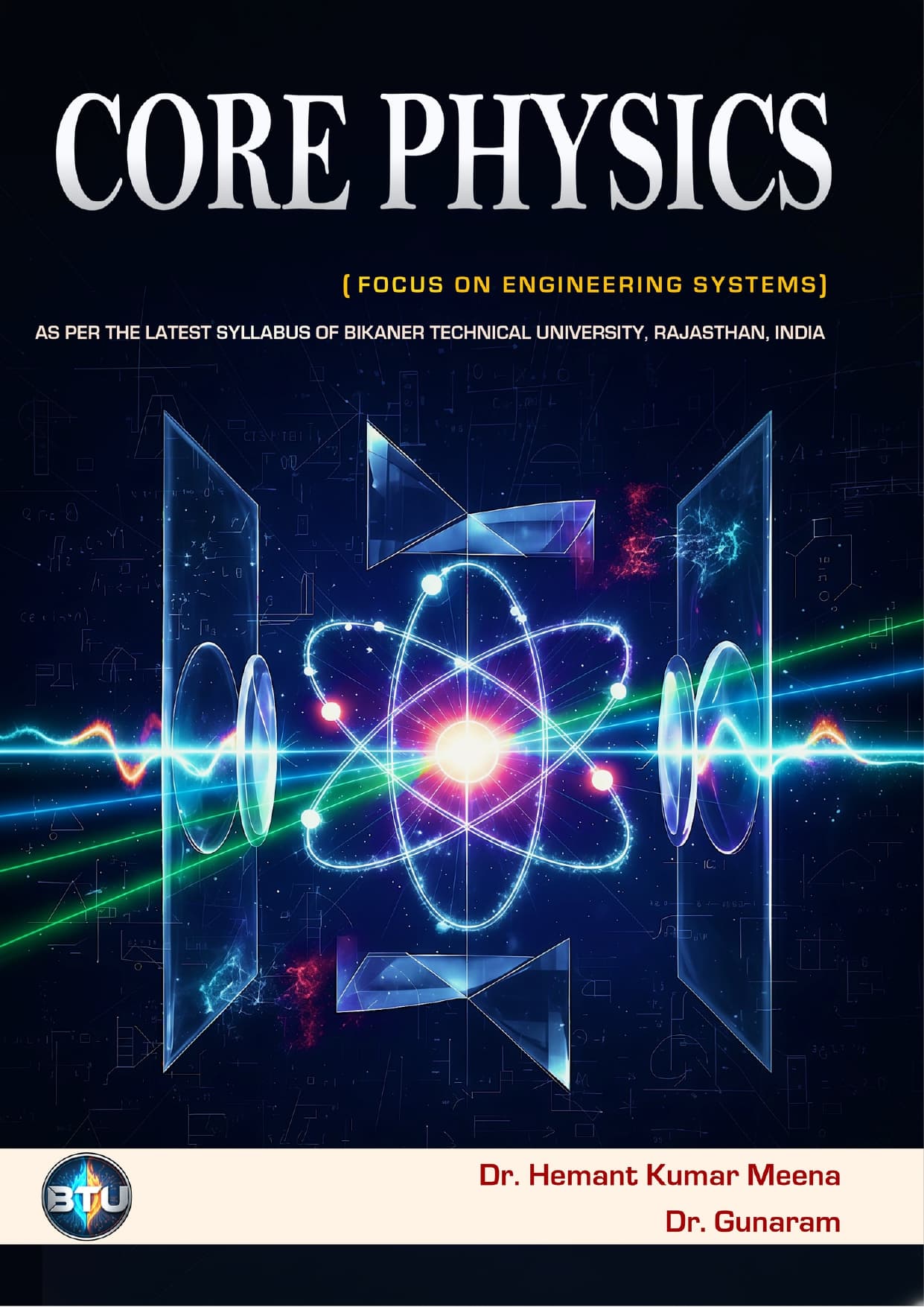
Authors: Dr. Hemant Kumar Meena, Dr. Gunaram
ISBN-13: 9789349554269
DOI: https://doi.org/10.5281/zenodo.18624120
Format: Paperback and e-book
Pages: 182
Product Dimensions: 6 x 9 inch
Publisher: Bharat Global Publications

Dr. Hemant Kumar Meena is a physicist and Assistant Professor associated with government institutes and universities in India, with over seven years of experience in research, teaching, and academic training. He holds a Master of Science degree in Advanced Physics with specialization in Microwave Electronics from MDS University, Ajmer. He has qualified the prestigious CSIR–UGC NET–JRF examination conducted by the Council of Scientific and Industrial Research(CSIR), Govt. of India.
Dr. Meena earned his Doctor of Philosophy (Ph.D.) in Physics from the Central University of Rajasthan, Ajmer, where he carried out his doctoral research at the Laser Matter Research [LMR] Laboratory. His Ph.D. work focused on high-order laser beam shaping, particularly the design and development of specialized computer-generated holograms [CGHs] for controlled optical energy modulation in high-order laser modes. His research interests encompass structured light beams from novel laser sources, super-oscillatory laser beams, phase-singular beams, non-diffracting and optical self-healing beams, ultrafast laser beam shaping, diffractive optics integrated with image processing, and controllable beam shaping in high-order laser modes. Dr. Meena has published several research articles, book chapters, and conference proceedings in reputed national and international journals.

Dr. Gunaram is a physicist currently serving as the Head of the Department of Physics at Government Engineering College, Ajmer, Rajasthan. He has over 25 years of experience in research, teaching, and academic training. He earned his Doctor of Philosophy (Ph.D.) in Physics with specialization in the field of planar antennas.
Dr. Gunaram has been actively engaged in full-time research alongside his academic responsibilities. His scholarly contributions include numerous research articles, book chapters, and conference proceedings published in reputed national and international outlets. He has presented several research papers at international conferences across the globe. His academic work and professional profile are also accessible through platforms such as Google Scholar, ResearchGate, Semantic Scholar, and LinkedIn.
Modern physics began in 1900 with Max Karl Ernst Ludwig Planck’s discovery of the role of energy quantization in blackbody radiation, a revolutionary idea soon followed by Albert Einstein’s equally revolutionary theory of relativity and quantum theory of light. Few aspects of contemporary science—indeed, of contemporary life— are unaffected by the insights into matter and energy provided by modern physics, which continues as an active discipline as it enters its second century. This book is intended to be used with course in modern physics for students who have already had basic physics and calculus courses. The book has been designed as a textbook for the beginners in several branches of Engineering according to the latest syllabus of Bikaner Technical University, Rajasthan, India. Syllabus of physics in engineering course is divided into two parts i.e. Applied physics & Engineering physics as per curriculum requirement in universities & engineering institutes in India. Engineering—physics is highly focussed on research/Development/improvement of the industry with technology. Although it is to cover several areas in a single book, this book provide better attempt to give a comprehensive account of a large number of important topics in this exciting field and should meet the requirements of a course meant for undergraduate students of science and engineering. In this book covered 5 chapters i.e., Chapter — 1: Emergence of Quantum theory, Chapter — 2: Explores the fundamental concepts and properties of advanced materials like: Semiconductors, Superconductor and Nanomaterials , Chapters —3: Deals with An overview to Electromagnetism, Chapter — 4: deals with Dielectric and Magnetic properties of materials, Chapter — 5: deals with Wave-Optics
Organization of Book
In 1st Chapter: The fundamental physical principles and experimental proofs which contradicted traditional classical mechanics and ultimately provided birth to quantum mechanics will be reviewed in this chapter. It is involves Heisenberg’s uncertainty principle and its physical significance, Wave function, Time independent Schrödinger wave equation, Application of Schrodinger wave equation – Energy eigen values for a free particle, and Energy eigen values of a particle in a 1D and 3D potential well of infinite depth with explanation of degeneracy and tunnelling effect.
In 2nd Chapter: The Physics of advanced materials(Semiconductors, Superconductor & Nanomaterials) explores the fundamental principles and properties that govern the behaviour and applications of innovative materials will be realize in this chapter. It delves into nanotechnology and the study of novel physical phenomena to unlock new frontiers in technology and science.
In 3rd Chapter: In this chapter, we explores the fundamental operation of vector theory with its physical significance like: Gradient, Divergence, Curl and consist the principles of Faraday and realize the Maxwell’s equation that govern the behaviour electromagnetic field, is also fundamental to understanding how light and other electromagnetic waves travel through space.
In 4th Chapter: Theodore H. Maiman was realized the first solid ruby laser in 1960. Lasers is a coherent electromagnetic radiation, which are ubiquitous and found application in user goods. This introductory chapter explained about the history and Einstein’s theory of laser action, properties of laser beams with details of He-Ne and semiconductor laser. At the end, we discussed about the motivation of Optical-fibres where students were gather the knowledge about principle & construction of optical fibres, Acceptance angle & Numerical aperture relations, modes of propagation of light through step-index, Graded index fibre. This section is provides the vital role of optical fibre & lasers in photonics and fibre-optics industry.
In 5th Chapter: In this introductory chapter, we examined the concepts of classical wave-optics events that are significant to the propagation of light. These concepts include the formation of an interference pattern through the division of amplitude in thin film and the diffraction spectrum via optical elements, with practical applications
The fundamental concepts of physics have been systematically structured and presented in this book in a coherent and optimized manner. The subject matter is explained with clarity and precision, using simple and accessible language supported by self-explanatory figures to facilitate effective learning. It is hoped that this book will serve as a valuable academic resource in strengthening students’ conceptual understanding and promoting analytical thinking in the essential principles of physics. The authors respectfully acknowledge the encouraging response received from physics faculty across universities and institutions and invite scholarly feedback and suggestions for the further enhancement of the subject content.